
Creating Inclusive Fitness Spaces for Beginners, Athletes, and Everyone Between
Oct 05, 2026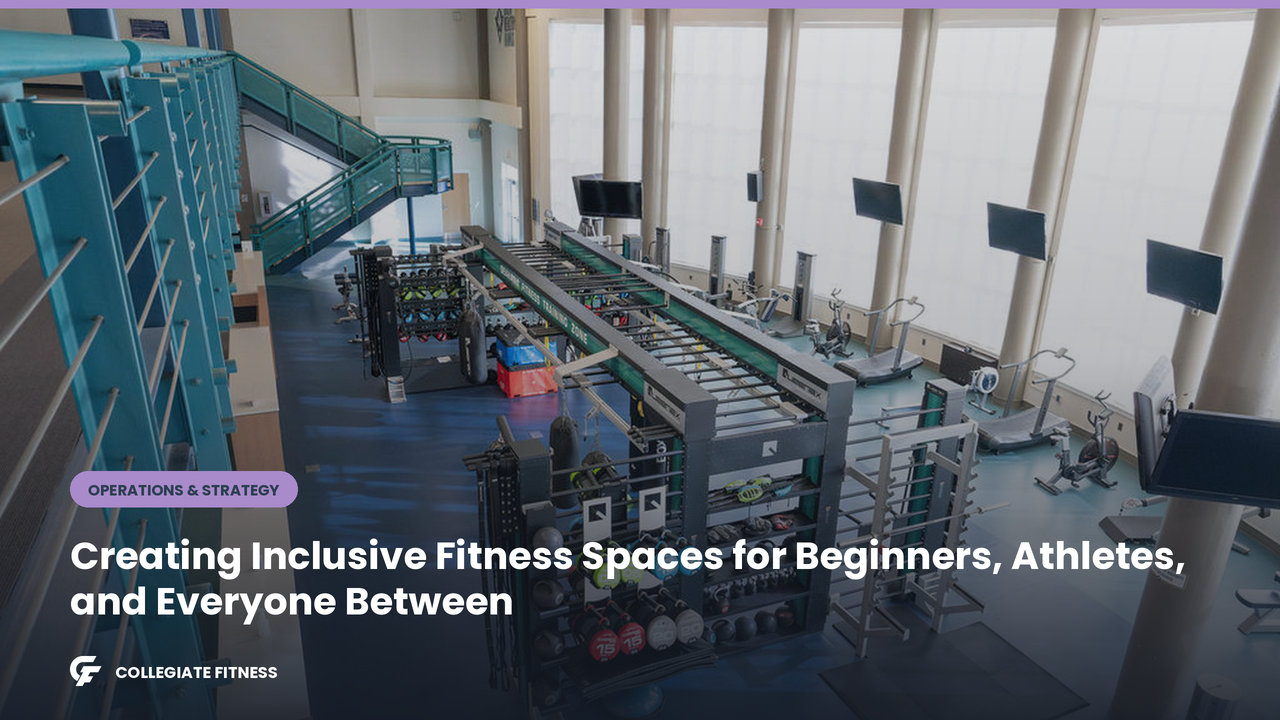
A recreation center's floor plan makes a hundred small arguments before a single class ever starts, and almost none of them are written down anywhere. The placement of the mirrors. Which room gets the glass wall facing the hallway and which one gets a solid door. Whether the free weights sit in an open, sightline-heavy area where every rep is visible to anyone walking past, or whether there's a quieter corner where someone can work through unfamiliar movements without an audience. Nobody drafts these decisions as statements about who belongs where. They get made for reasons that feel entirely practical: this room has better acoustics, that space had leftover square footage, this layout maximizes equipment count. And yet the finished building ends up saying something anyway, clearly enough that students read it within their first five minutes inside.
This is the part of inclusive fitness programming that gets the least attention, because it's the hardest to fix with a new class schedule or a softer marketing campaign. Language and imagery can be rewritten in a week. A building's architecture and its long-established zoning of who goes where cannot, and so the harder, more interesting work in campus recreation right now isn't happening in the marketing meeting. It's happening on the floor plan.
Space Tells the Truth Even When Marketing Doesn't
Every fitness facility, whether or not anyone designed it this way on purpose, ends up sorting its population by intensity and confidence level, and that sorting is almost always visible if you know to look for it. The competitive lifters cluster in the area with the heaviest equipment and the most mirrors. The students newer to structured exercise gravitate toward whatever corner feels furthest from observation, often a cardio machine facing a wall rather than the open floor. Over time, without anyone announcing it, these informal territories calcify into something closer to policy. New students learn, correctly, which parts of the building are "for" people like them, and the building keeps teaching that lesson to every new class of first-years long after the staff member who originally designed the layout has moved on.
The instinct, once a department notices this pattern, is often to solve it by formalizing the separation that already exists: build a dedicated beginner room, distinct from the main weight floor, so newer students have a space explicitly designed for them. That instinct comes from genuine care, and in some cases it does lower the barrier to a first visit. But departments that have tried it report a consistent, somewhat uncomfortable finding: a permanent beginner room can just as easily calcify into a permanent beginner room, a space students eventually feel pressure to graduate out of, or worse, a space some students never leave because crossing into the "real" weight floor starts to feel like a test they haven't yet earned the right to take. Separating by ability, even when well-intentioned, tends to reinforce the very hierarchy it was meant to dissolve.
What Integration Actually Looks Like
The more durable alternative isn't separation. It's a kind of intentional blending, where the same physical space is genuinely used by a wide range of students at a wide range of skill levels, at the same time, without the layout itself forcing anyone into a lane. This is harder to design than a beginner room, because it requires thinking about equipment placement, sightlines, and staff presence as a single connected system rather than solving each piece in isolation.
Equipment placement matters more than most departments give it credit for. A facility where the most advanced equipment sits in the most visually dominant, most heavily trafficked part of the floor sends an unmistakable signal about hierarchy, regardless of what the mission statement says. Distributing equipment so that a squat rack and a set of resistance bands occupy comparably prominent locations, rather than banishing the beginner-friendly equipment to a back corner, quietly undoes some of that hierarchy without requiring a single new sign or slogan.
Staff presence does even more work than equipment placement, and it's considerably cheaper to change. A staff member trained to walk the floor, make eye contact, and offer a quick, low-pressure check-in to anyone who looks uncertain, functions as a kind of human translation layer between an intimidating space and a new student's willingness to stay in it. This isn't about hovering or turning every unfamiliar face into a teaching moment nobody asked for. It's about making sure that the first thirty seconds a nervous student spends on an unfamiliar floor include at least one small, genuine signal that someone in the building is glad they came. Departments that have trained student staff specifically around this kind of ambient welcome, rather than leaving it to individual personality, report a noticeably different atmosphere on the floor within a single semester.
Let the Data Tell You Where the Gaps Are
Most recreation centers already collect the exact information they'd need to find their own blind spots. Facility use data, hour by hour, space by space, sits in scheduling software and access-control systems largely unexamined, treated as an operational record rather than a diagnostic tool. That's a missed opportunity, because usage data tends to surface exactly the kind of pattern that's invisible from inside daily operations: a racquetball court booked at four percent capacity for three straight years, a mid-morning window when the entire building sits nearly empty, a class format that fills instantly at 5 p.m. and never once fills at 7 a.m., even though the 7 a.m. slot exists specifically because someone once assumed early risers wanted intensity.
Reading that data honestly, rather than defensively, tends to point departments toward the same conclusion again and again: dead space is rarely dead because nobody wants to use it. It's dead because nothing currently offered in that space, at that hour, is something the students who could access it actually want. A chronically underbooked racquetball court is not evidence that students don't value quiet, lower-intensity space. It's evidence that a department has been offering the wrong thing in the right location. Departments that have acted on this, converting underused courts into mobility studios or quiet strength spaces, aren't guessing. They're following a signal that was sitting in their own scheduling system the entire time.
The Beginner and the Athlete Are Not as Far Apart as the Floor Plan Suggests
There's a quieter assumption buried underneath most facility segregation that deserves to be questioned directly: the idea that a competitive athlete and a first-time gymgoer fundamentally want different environments, and that serving one well means compromising the experience of the other. In practice, that assumption holds up far less often than facility design tends to imply. A well-run strength class, structured with tiered intensity options taught by a single confident instructor, routinely draws both populations into the same room without friction, because what both groups are actually seeking, competent instruction, a sense of progress, and a room that doesn't make them feel like an outsider, turns out to be nearly identical. The differentiation they need is in the programming, not in the walls.
What separates the two groups more than ability level is confidence, and confidence is shaped far more by how a space treats a person in their first thirty seconds inside it than by the equipment available once they're in. A facility that greets every visitor, regardless of visible fitness level, with the same competent, unhurried welcome will do more to close the gap between beginner and athlete than any amount of physical segregation ever could. The goal was never to make the weight floor less serious. It was to make seriousness something anyone gets to grow into, rather than something they have to already possess before the building will let them in.
The recreation centers quietly getting this right aren't necessarily the newest or best-funded ones. They're the ones that finally started reading their own floor plans the way a first-time visitor would, and had the discipline to change what the building had been saying long before anyone bothered to translate it.
Want to Be Part of These Conversations?
If you’re a collegiate fitness or campus recreation professional looking to stay ahead of trends, connect with peers, and bring new ideas back to your program, this is exactly what the Collegiate Fitness Community is built for.
Join a growing network of fitness directors and leaders sharing real strategies, insights, and what’s working right now.
Stay Ahead in Collegiate Fitness
Get insights, trends, and real-world strategies from collegiate fitness leaders. Stay connected to what’s working across campus recreation.
We hate SPAM. Unsubscribe at any time.