
Recovery Is No Longer a Trend: Why Campus Recreation Should Treat Recovery as Programming
Jul 20, 2026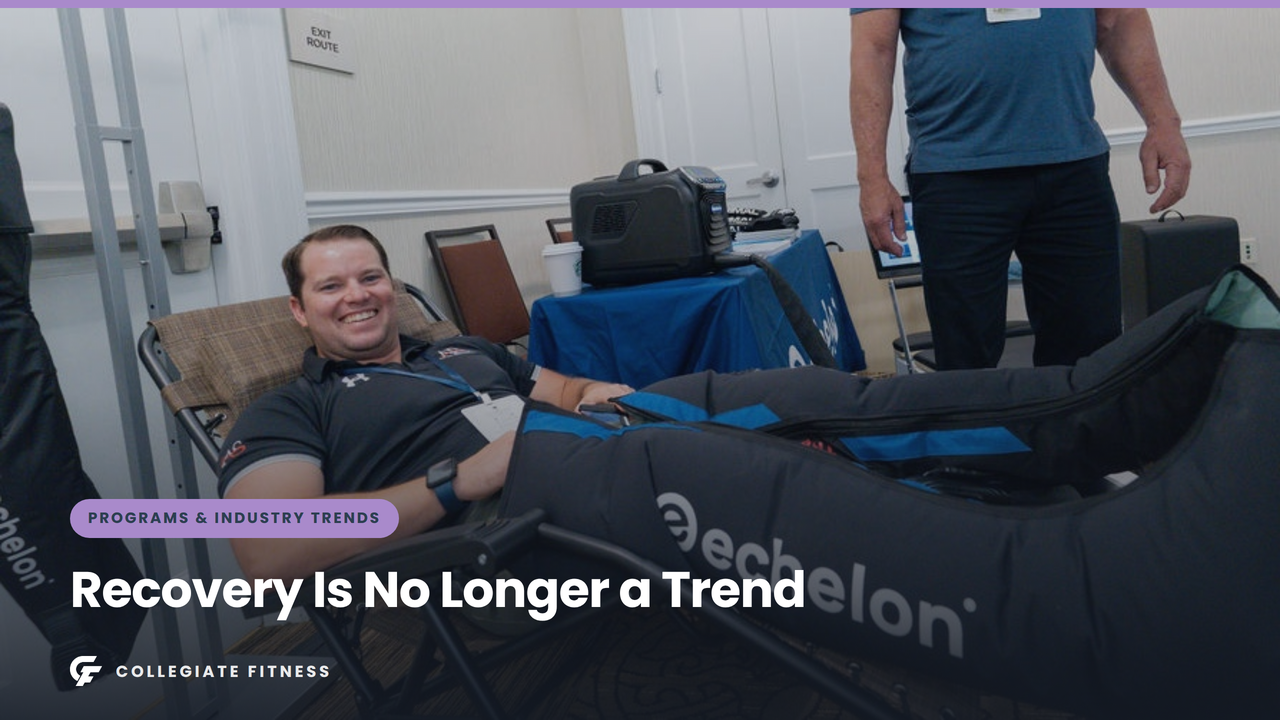
Every industry has a tell for when a good idea is about to be ruined by its own popularity, and in fitness, the tell is usually a shopping list. Cold plunge. Infrared sauna. Percussion massage gun station. Compression boots. A vendor walks the floor, a director gets excited, a purchase order gets signed, and six months later there's a beautiful, underused corner of the building that cost five figures and gets touched by maybe a dozen students a week, most of whom aren't entirely sure what they're supposed to be doing with it.
This is the trap collegiate recreation is at real risk of falling into with recovery. The impulse to treat it as a category of equipment, something you can acquire your way into, is understandable. It's also exactly backwards. The departments getting real value out of the recovery movement have stopped thinking of it as a purchase and started thinking of it as a curriculum. That distinction, small as it may sound, is the difference between a corner of the gym that nobody uses correctly and a genuine competitive advantage.
The Equipment Was Never the Point
Consider a scenario that's playing out, in some version, on campuses everywhere right now: a department invests in a full recovery buildout, saunas, cold plunges, guided stretching stations, the works, and attendance never quite materializes the way the pitch deck promised. The equipment isn't broken. The theory isn't wrong. What's missing is almost always the same thing: nobody taught anyone what to do.
That gap matters more than it seems like it should, because recovery modalities carry a strange kind of intimidation that regular gym equipment doesn't. A student who has never touched a barbell can watch someone else use one and pick up the basic idea. A student who has never used a cold plunge has no reference point at all. There's no intuitive on-ramp to submerging yourself in fifty-degree water, and if the only instruction available is a laminated sign taped to the wall, most students will simply avoid the whole area rather than risk doing it wrong in front of strangers. The equipment sits there, expensive and idle, not because students don't want recovery, but because the department skipped the part of the process that actually makes recovery accessible.
The fix isn't complicated, but it does require treating education as the primary investment and equipment as a secondary one. A short protocol taught by a staff member who can explain not just the how but the why, tied to something as simple as an orientation session, changes the entire trajectory of whether that equipment gets used. Recovery, in other words, isn't a room. It's a body of knowledge that has to be transmitted, the same way strength training or nutrition guidance has to be transmitted, and departments that skip that step are essentially furnishing a room and hoping.
Recovery Has to Live Inside the Schedule, Not Beside It
There's a second, subtler mistake showing up across campus recreation right now, and it has less to do with equipment and more to do with the calendar. Many departments have added recovery-adjacent offerings, a yoga class here, a mobility session there, without ever asking a more fundamental question: what does the schedule actually look like for someone who can only show up once a day, at one fixed hour?
This matters because most students, and for that matter most staff, don't have the flexibility to chase programming around the clock. If someone's only available window is 6 a.m., and the only thing on offer at 6 a.m. is a maximal-effort interval class, that person has effectively been locked out of ever encountering recovery programming at all, regardless of how well-designed it is elsewhere in the week. A single high-intensity slot at the only hour a person can attend isn't a scheduling inconvenience. It's a structural exclusion, and it's one most departments never notice because the people it excludes simply stop coming rather than complain.
Solving this doesn't require doubling the class schedule or building an entirely new facility. It requires distributing recovery-oriented programming across every hour a facility operates, rather than clustering it in the late afternoon slots that already tend to attract the students most inclined to seek it out. A mobility-focused session at 6 a.m., a breathwork-based cooldown built into an early lunch slot, a lower-intensity option threaded into the evening rotation alongside the high-energy class that already dominates that hour. The goal isn't to replace intensity. It's to make sure recovery isn't something only available to people with flexible schedules, because those people were rarely the ones who needed it most urgently in the first place.
The Business Case Nobody's Making Loudly Enough
Recovery programming tends to get pitched, when it gets pitched at all, as a wellness initiative, something virtuous but soft, nice to have if the budget allows. That framing undersells what's actually happening. There's a hard, unsentimental business case sitting underneath the wellness language, and it has to do with two numbers that rarely get discussed in the same conversation: the industry average gym membership retention window, and the documented injury rate among instructors who only ever teach high-intensity formats.
On the member side, the pattern is stark. The average person who joins a gym stops showing up within about six weeks. That's not a campus recreation statistic specifically; it's an industry-wide one, but there's no obvious reason to assume college students are immune to it, and every reason to think a first-year student navigating an unfamiliar building for the first time might be even more susceptible. A recovery-forward facility, one that meets people at whatever intensity they can sustain rather than funneling everyone toward the hardest option on the schedule, has a real shot at extending that window, because it's not asking students to either go all in or opt out entirely.
On the staff side, the number is even harder to ignore. Fitness professionals who exclusively teach high-intensity, high-impact formats tend to sustain their first injury within roughly nine months on the job. That's not a personal failing of the instructor. It's a predictable outcome of a staffing model that treats recovery as something instructors are responsible for managing on their own unpaid time, if they manage it at all. A department that builds recovery education and recovery time directly into staff training and staff scheduling isn't just being a considerate employer. It's protecting the return on every dollar it spent recruiting and training that instructor in the first place, because losing a trained group fitness leader to injury nine months in is an expensive, avoidable failure of program design.
Put those two numbers together, and the wellness framing starts to look like a significant undersell. Recovery programming, done right, is a retention strategy on both sides of the relationship, the student side and the staff side, and retention is the single most expensive problem in the entire fitness industry to solve badly.
What "Recovery as Programming" Actually Looks Like
The departments furthest ahead on this aren't necessarily the ones with the biggest recovery budgets. They're the ones who've stopped treating recovery as a line item and started treating it as a design principle that touches everything else they do. That shows up in small, unglamorous decisions more often than it shows up in ribbon-cutting ceremonies: a racquetball court quietly converted into a mobility studio because the racquetball courts weren't getting used anyway, a first-week orientation session built specifically around teaching new students how to use recovery equipment before they're ever expected to seek it out on their own, a semester-long staff education plan that treats recovery training with the same seriousness as certification renewal rather than as an occasional optional workshop.
None of that requires the kind of capital investment that makes for an impressive vendor booth. It requires believing that recovery is infrastructure, in the same category as scheduling software or staff training, rather than an amenity, in the same category as a juice bar or a rock climbing wall. Amenities are things people notice when they're deciding whether to join. Infrastructure is what determines whether they're still coming eighteen months later, still uninjured, still finding value in a building that never asked them to prove how hard they could go before it would let them belong there.
The corner with the cold plunge in it isn't going anywhere. But if it's still sitting mostly empty a year from now, the problem was never the equipment. It was the assumption that buying recovery was the same thing as building it.
Want to Be Part of These Conversations?
If you’re a collegiate fitness or campus recreation professional looking to stay ahead of trends, connect with peers, and bring new ideas back to your program, this is exactly what the Collegiate Fitness Community is built for.
Join a growing network of fitness directors and leaders sharing real strategies, insights, and what’s working right now.
Stay Ahead in Collegiate Fitness
Get insights, trends, and real-world strategies from collegiate fitness leaders. Stay connected to what’s working across campus recreation.
We hate SPAM. Unsubscribe at any time.