
From "Go Harder" to "Find What Works for You": Rethinking Fitness Marketing in Campus Recreation
Aug 11, 2026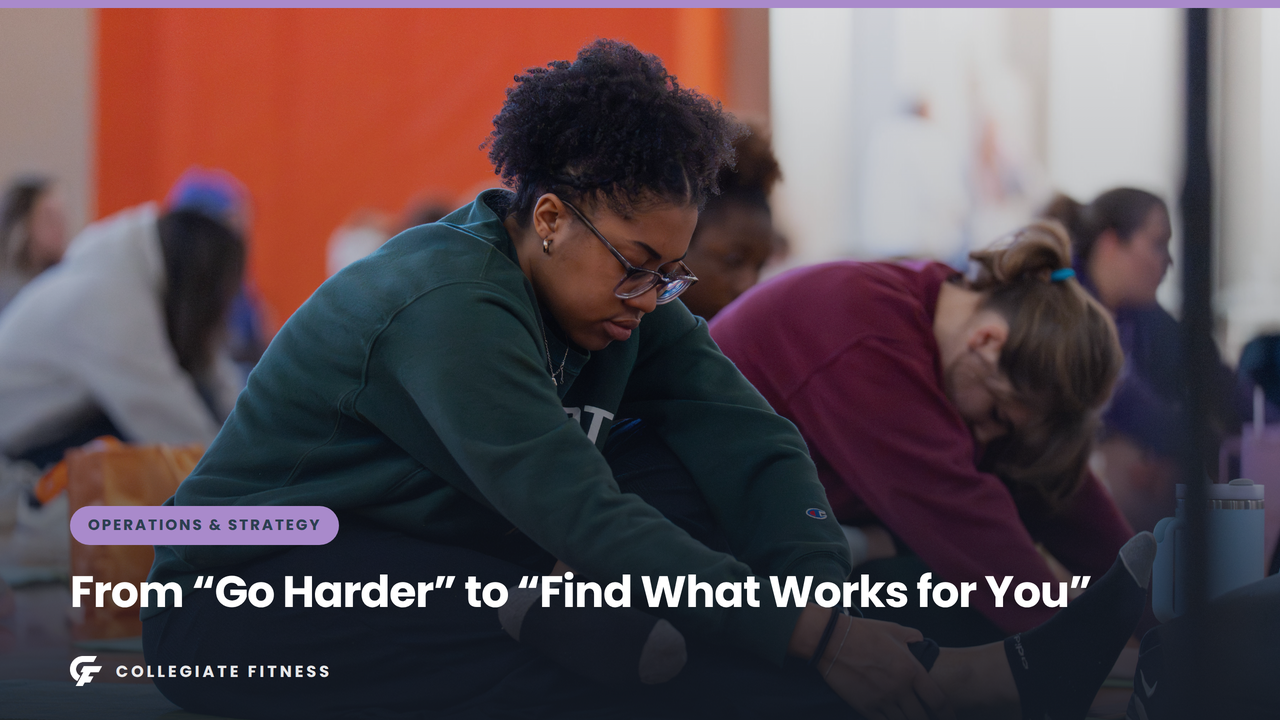
Somewhere in a filing cabinet, or more likely a shared drive nobody has cleaned out in years, most collegiate recreation departments are still sitting on a library of promotional photography that tells on them. Sweat mid-drip. Faces contorted somewhere between effort and pain. A cheerful, oblivious caption underneath, urging students to "crush" their goals or unlock "beast mode." It was shot with good intentions, by staff who genuinely believed they were selling energy and aspiration. What it actually sold, to a meaningful share of the students who saw it, was a very clear message: this is not for you, not yet, maybe not ever.
That gap, between what a department believes its marketing communicates and what students actually receive from it, is one of the more consequential blind spots in collegiate recreation right now, and it's largely invisible from the inside. Nobody sets out to make a facility look intimidating. But intimidation doesn't require intent. It just requires a consistent visual and verbal vocabulary that rewards a very narrow definition of what fitness is supposed to look like, repeated often enough that students absorb the message before they ever set foot in the building.
The Tour Guide Problem
There's a small, almost throwaway moment that captures the issue better than any focus group could. A prospective student, walking through a recreation center on a campus tour, gestures toward the weight room and describes it to the group, half-joking but not entirely, as "the scary floor." Nobody on that campus meant to build a scary floor. The equipment is the same equipment every recreation center has. The lighting is the same lighting. But somewhere along the way, through years of marketing that showcased only the most visibly athletic students in the most visibly intense poses, that particular room accumulated a reputation, and reputations, once set, are remarkably durable. They outlast the actual environment they describe.
This is the uncomfortable truth at the center of fitness marketing in campus recreation: the message rarely lives in a single flyer or a single Instagram post. It lives in the accumulation of thousands of small choices, made over years, about who gets photographed, what kind of body gets centered in a promotional graphic, which words get used to describe effort, and which class formats get the marketing budget and prime real estate on the website. A department can write an inclusive mission statement and still, through pure repetition of imagery, teach every student walking through its doors exactly who that space was built for and who's merely tolerated there.
Language Is Doing More Work Than Anyone Realizes
If there's a single word substitution that captures where campus recreation marketing needs to head, it's the shift from "exercise" to "movement." It sounds like a minor stylistic choice, the kind of thing a copywriter might flag and move past. It isn't. "Exercise" arrives pre-loaded with a decade of gym-class humiliation, diet culture, and an implicit hierarchy of who's doing it correctly. "Movement" carries none of that weight. It leaves room for a student managing an old injury, a student who has never set foot in an organized fitness space, a student whose body doesn't resemble anything in the promotional photography, to encounter the phrase without first having to clear a psychological hurdle just to see themselves in it.
This kind of language audit rarely gets the attention it deserves, because it doesn't feel like marketing in the traditional sense. It feels like semantics. But semantics is exactly the terrain where a department either signals belonging or signals exclusion, and it does so faster and more durably than any single campaign can undo. A class called "Shred" and a class with the same content called "Foundations" will not draw the same student to the door, even if the workout inside is identical. The name isn't decoration. It's a filter, deciding in advance who feels invited to walk in and who quietly assumes the class was built for someone else.
The same logic applies at the level of an entire marketing strategy, not just individual class names. The instinct to lead every campaign with the most visibly intense, most visibly fit student on campus comes from a reasonable place, that image is aspirational, it photographs well, it performs on social media. But it also teaches every student who doesn't look like that exactly what they're not supposed to expect from the space. Marketing built entirely around a single body type and a single intensity level isn't neutral advertising. It's a sorting mechanism, and it sorts far more people out than it draws in.
What "Come As You Are" Actually Requires
The phrase circulating now among the departments getting this right, come as you are rather than go harder, sounds simple enough to write on a banner and call finished. It isn't a banner. It's an operating philosophy that has to show up consistently across every touchpoint a student encounters, or it collapses under its own contradiction the moment a student notices the gap between the message and the reality.
That consistency is harder than it sounds, because it requires a department to look honestly at places where its actual environment contradicts its stated values. If the marketing says everyone belongs but the facility segregates competitive athletes from beginners into physically separate spaces, the environment is telling a truer story than the campaign is. If the website photography features only lean, visibly athletic bodies while the actual daily population of the gym looks nothing like that, students will notice the discrepancy quickly, usually within their first visit, and they'll trust what they see over what they were told. Marketing that promises inclusion has to be backed by a facility, a class schedule, and a staff culture that actually delivers it, or the promise becomes a liability, a reason for a student to feel misled rather than welcomed.
The departments doing this well tend to start with something unglamorous: an honest audit of their own existing content. Not a rebrand, not a new tagline, but a genuine inventory of what their photography, their class names, their social captions, and their signage have actually been communicating, often for years, without anyone stopping to ask. That audit tends to surface the same pattern almost everywhere it's conducted: a handful of high-intensity offerings absorbing the overwhelming majority of marketing attention, while beginner-friendly and recovery-oriented programming, often the very offerings a department is trying to grow, gets described in a single line at the bottom of a schedule, if it gets described at all.
Marketing Begins Before the Marketing Does
There's a temptation, once a department recognizes this problem, to solve it entirely at the campaign level: new photography, softer language, more diverse imagery in the next round of social posts. That's necessary, but it's incomplete, because marketing in campus recreation doesn't actually begin with the marketing team. It begins with the first-year student's very first experience walking through the door, and everything the campaign says has to be true of that experience or the campaign is just decoration on top of a structural problem.
This is where first-year fitness cohorts and orientation-based programming turn out to matter more than they initially seem to. A structured, low-stakes entry point, something that lets a new student experience the space alongside peers who are equally unfamiliar with it, does more to establish belonging than any amount of inclusive copywriting ever could, because it replaces a message with an experience. The student who joins a first-year cohort isn't being told the space is for them. They're discovering it firsthand, in a context designed specifically to remove the intimidation a solo first visit would otherwise carry.
Seen this way, marketing and programming stop being separate departments with separate budgets and start looking like the same project, viewed from two different angles. The photography and the language are the promise. The first-year cohort, the beginner-friendly class times, the staff trained to welcome rather than assess, are the delivery on that promise. A department that gets the first part right and neglects the second will eventually get caught in the gap between them. A department that gets the second part right, even with modest marketing, tends to build the kind of word-of-mouth trust that no campaign budget can buy, because students who felt genuinely welcomed become the most credible messengers a recreation center will ever have.
The recreation centers that will define the next era of collegiate fitness aren't the ones with the most polished campaign. They're the ones willing to look honestly at what their photography has been saying for years, and brave enough to ask whether the story they've been telling was ever actually true.
Want to Be Part of These Conversations?
If you’re a collegiate fitness or campus recreation professional looking to stay ahead of trends, connect with peers, and bring new ideas back to your program, this is exactly what the Collegiate Fitness Community is built for.
Join a growing network of fitness directors and leaders sharing real strategies, insights, and what’s working right now.
Stay Ahead in Collegiate Fitness
Get insights, trends, and real-world strategies from collegiate fitness leaders. Stay connected to what’s working across campus recreation.
We hate SPAM. Unsubscribe at any time.