
Stop Marketing Your Programs. Start Creating Stories Worth Sharing.
Oct 12, 2026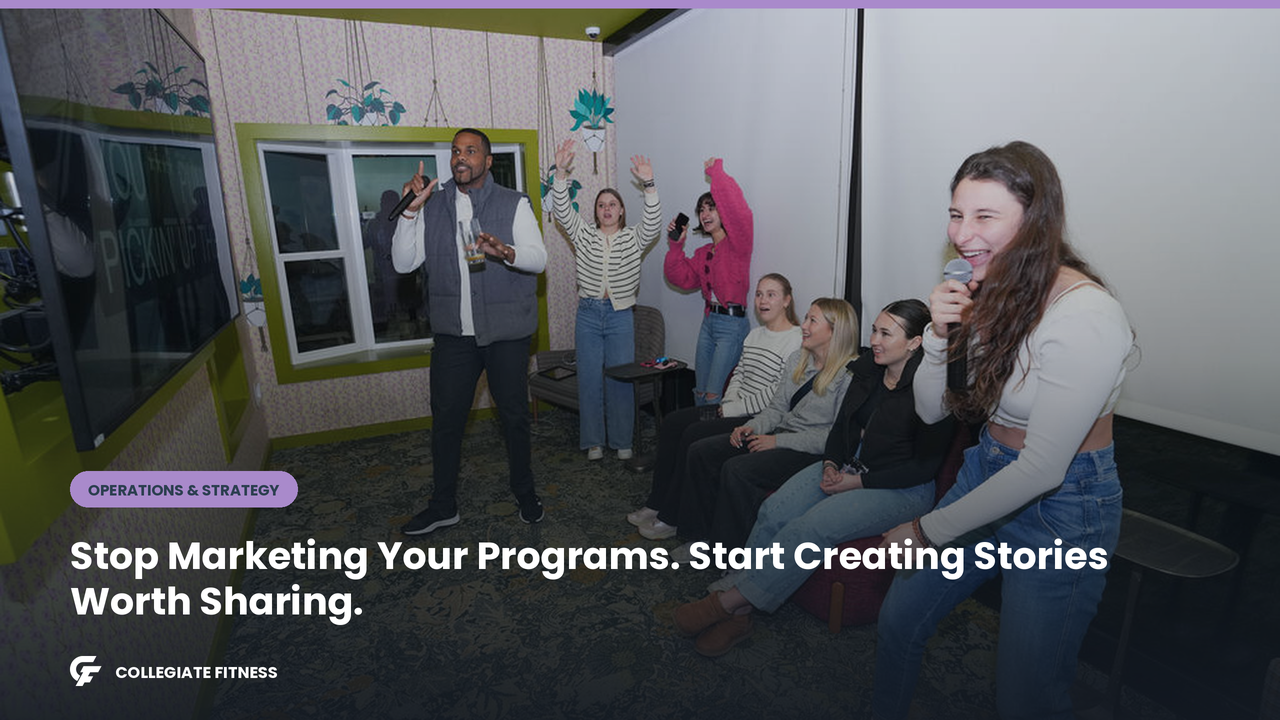
Somewhere on a college campus this semester, a cycling instructor is about to run a karaoke-themed spin class, and the student conduct office has set up a mocktail bar at the back of the room. It's an alcohol awareness event, technically, filed under wellness education in whatever spreadsheet tracks programming outcomes. But nobody riding a bike and belting out a chorus badly is thinking about alcohol awareness. They're thinking about how absurd and fun this hour turned out to be, and by the time they've posted a video of it, tagged three friends who should have come, and told their roommate about it at dinner, the actual marketing has already happened, days before anyone in a marketing department ever touched the story.
This is the part of campus recreation marketing that keeps getting the sequence backwards. Departments spend enormous energy trying to generate awareness first, hoping a well-designed flyer or a polished social post will be compelling enough to draw students toward a program they haven't experienced yet. But awareness built from nothing, manufactured before the actual experience exists, rarely converts into participation, because it's asking students to trust a promise rather than react to something real. The departments getting genuine traction have discovered, usually by accident at first, that the sequence works far better in reverse. Build something worth talking about. Let the experience generate the story. Then let the story do the marketing's actual job, which was never to manufacture interest out of nothing, but to amplify something that already deserved attention.
Programming Is the First Draft of the Marketing
There's a habit, deeply ingrained across most recreation departments, of treating programming and marketing as sequential, separate functions: first you build the program, then you hand it off to marketing to promote. That sequencing quietly assumes marketing's job is to take something inherently unremarkable and dress it up into something compelling. But the departments producing content that actually spreads have stopped treating marketing as a costume applied after the fact, and started treating the programming itself as the raw material the marketing is built from. A vertical jump challenge, a hundred-meter rowing sprint competition, a grip strength contest that unexpectedly goes viral among students who'd never have signed up for a structured fitness class, aren't marketing tactics dressed up as programming. They're programming designed, from the outset, with the awareness that a genuinely interesting experience is the only reliable source of content that people actually want to watch.
This distinction matters because it changes where creative energy gets spent. A department chasing engagement through better captions and more frequent posting is optimizing the wrong variable. A department that spends its creative energy designing an event distinctive enough that participants want to document it themselves, tag their friends in it, mention it unprompted in conversation, has solved the actual problem, because the resulting content isn't manufactured. It's evidence. There's a meaningful difference between a flyer telling students a program is fun and a video of actual students visibly, audibly having fun at that program, and algorithms, along with the students scrolling past them, can tell the difference instantly.
The Story Has to Exist Before the Marketing Team Can Tell It
One of the more persistent frustrations circulating through campus recreation right now involves the relationship between recreation staff and centralized university marketing departments, who often move on a slower timeline, work from a different set of priorities, and don't always have the bandwidth to dig up compelling material on their own. It's tempting to read this as a marketing department problem, and sometimes it genuinely is. But the more productive framing, the one departments actually making progress have landed on, treats it as a sequencing problem instead: a marketing team asked to promote a program with no distinctive story and no usable assets is being set up to produce something generic, because generic is the only honest output of vague input.
The fix isn't waiting for marketing to become more responsive. It's arriving at the marketing conversation already holding the story, rather than expecting the marketing team to excavate one. What makes this program different from anything else on campus. Why should a student who's never set foot in the recreation center care about this specific event over the dozen other things competing for their Tuesday evening. That story doesn't originate in a marketing department, because marketing departments weren't in the room when the program was designed. It originates with the people who built the experience, and it has to be identified and articulated before anyone else can be expected to communicate it convincingly. A recreation professional who shows up to a marketing meeting with a clear story, real photos, and usable video footage isn't asking marketing to create something from nothing. They're asking marketing to amplify something that already exists, which is a fundamentally easier and faster request, and it tends to get treated that way.
Letting Students Tell It Themselves
There's a related shift happening in who actually gets entrusted to tell these stories, and it cuts against the instinct of most professional communications teams to keep messaging tightly controlled. The departments seeing the strongest organic reach have started handing meaningful creative control to their student staff, not as a cost-saving measure, though it often is one, but because students understand the current rhythm of what actually resonates with other students in a way that a polished institutional account, however well-intentioned, structurally cannot replicate. A prompt as simple as asking what gives people the "ick" at the recreation center, an open invitation for students to call out pet peeves, unreturned weights, hovering near equipment, awkward gym etiquette, generates more genuine engagement than a carefully composed brand message ever could, because it doesn't read like marketing at all. It reads like something a friend would post.
This is the deeper principle hiding underneath the specific tactic: students trust students in a way they simply do not trust institutional messaging, however sincere that messaging might be. A testimonial from a participant describing why they joined a program and what it actually changed for them carries a credibility that no professionally shot promotional video can match, because the audience instinctively knows the difference between someone being paid to say something and someone choosing to say it. Departments that have started building their content strategy around amplifying real participant voices, rather than exclusively producing polished institutional content, are tapping into a form of trust that money literally cannot buy.
Grassroots Channels Outperform the Obvious Ones
The instinct to concentrate marketing effort on the department's own social media channels makes intuitive sense, but it overlooks some of the most effective distribution channels sitting in plain sight, ones that were never designed as marketing infrastructure at all. A group fitness schedule slipped into every incoming freshman's dorm room through a partnership with residence life reaches an audience that a social media post, however well-targeted, would take months to accumulate through organic growth. A booth at a campus community fair, run by personal training staff hosting an unexpected fitness challenge, puts a recreation department's programming directly in front of students who had no prior intention of encountering it that day. Cross-departmental collaborations, a Pilates class hosted with a varsity athletic team, a partnership with student conduct or counseling services around a themed wellness event, extend a department's reach into communities of students who would never have found the recreation center's own channels on their own.
None of these channels require a marketing budget in the traditional sense. What they require is a willingness to see the entire campus, not just the recreation department's own social feeds, as available real estate for a good story to travel through. The departments treating grassroots partnerships as a core strategy, rather than an occasional nice-to-have, are consistently finding that these unglamorous, relationship-driven channels outperform far more expensive digital efforts, because they arrive with an implicit endorsement, this program is worth your attention, from a source the student already trusts.
The Flyer Was Never Going to Be the Thing People Remembered
Nobody, years from now, is going to describe their college recreation experience by recalling a particularly well-designed flyer. They're going to describe the karaoke spin class, the grip strength competition that got unexpectedly competitive, the instructor who remembered their name, the event that became, without anyone planning it that way, the thing their friend group still brings up at reunions. Marketing, in the truest sense, was never actually the flyer's job to begin with. It was the department's job, achieved not through better promotional design but through building something genuinely worth experiencing and then getting out of the way long enough to let the story travel on its own. The departments that understand this aren't spending less on marketing. They're spending it in an entirely different place, at the very beginning, where the actual story gets built, long before anyone opens a design template at all.
Want to Be Part of These Conversations?
If you’re a collegiate fitness or campus recreation professional looking to stay ahead of trends, connect with peers, and bring new ideas back to your program, this is exactly what the Collegiate Fitness Community is built for.
Join a growing network of fitness directors and leaders sharing real strategies, insights, and what’s working right now.
Stay Ahead in Collegiate Fitness
Get insights, trends, and real-world strategies from collegiate fitness leaders. Stay connected to what’s working across campus recreation.
We hate SPAM. Unsubscribe at any time.