
Why Student Staff Leave...and What Collegiate Recreation Leaders Can Do About It
Oct 26, 2026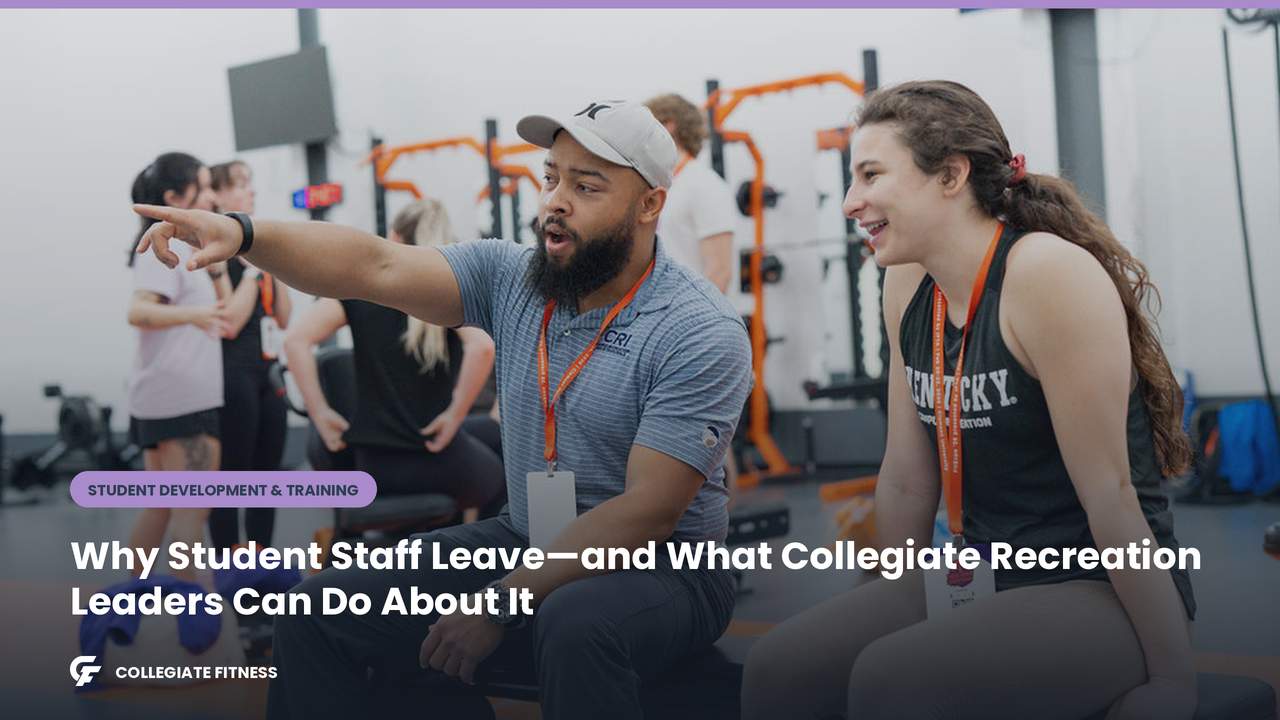
Exit interviews in collegiate recreation tend to produce the same short, unsatisfying list of reasons a student employee is walking away: schedule conflicts, a heavier course load, a job off campus that pays better. Supervisors write the reason down, file the paperwork, and post the position again, and the explanation feels complete enough that nobody questions it. But talk to enough fitness directors who have actually sat across from a departing student and pressed a little further, past the polite reason offered for the record, and a different pattern starts to surface, one that has almost nothing to do with pay or scheduling and almost everything to do with a much quieter kind of dissatisfaction. The student didn't leave the job. They left the way the job made them feel.
That distinction, small as it sounds, is the entire ballgame. A scheduling conflict is a logistics problem, solvable with a spreadsheet. A student who never felt like their supervisor actually knew them, who clocked in and out for a semester without anyone asking a genuine question about their life outside the building, is a culture problem, and culture problems don't show up on exit paperwork because nobody wants to be the student who admits, on their way out the door, that the real reason was that nobody seemed to notice they were there.
The Ten-Second Conversations Nobody Was Trained to Have
Ask any group of collegiate recreation supervisors what makes an exceptional student instructor, and the conversation will almost always start with technical competence: they know the material, they can cue a movement correctly, they show up on time and prepared. That answer isn't wrong. It's just radically incomplete, and the departments doing the best job of retaining student staff have generally figured out why.
Consider the difference between two supervisors greeting the same instructor before a shift. One walks past with a nod, focused on the clipboard, mentally running through the day's logistics. The other stops for ten seconds. I know you got married last month, how was the honeymoon, you look like you're glowing. Ten seconds, maybe less. It costs nothing in scheduling terms and shows up nowhere on a performance evaluation. And yet that ten-second exchange is very often the entire reason a student comes back the following week, not because the workout that day was exceptional, but because someone in a position of authority over their time and their paycheck took a moment to remember they existed as a full person, with a life that extends past the clipboard.
This is uncomfortable territory for a field that has spent years building its professional development around certifications, technique corrections, and programming knowledge, because none of that infrastructure teaches a supervisor how to have a ten-second conversation that actually lands. It isn't covered in a CPR recertification. It isn't part of any exam. Supervisors who are naturally good at it tend to describe it as instinct rather than skill, which makes it sound unteachable, and that assumption is exactly what's costing departments their best people. The ability to notice, to ask, to remember the detail a student mentioned three weeks ago and bring it up unprompted, is a skill like any other. It just isn't one collegiate recreation has historically bothered to train.
People Don't Leave Jobs. They Leave Situations.
There's a sentence circulating through collegiate recreation leadership right now that deserves to be taken more literally than most management aphorisms: people don't leave jobs, they leave situations. It sounds like the kind of thing printed on a motivational poster, easy to nod along with and just as easy to forget by the next staff meeting. But sit with what it actually implies, and it becomes a genuinely useful diagnostic tool rather than a slogan.
A situation, in this sense, is the accumulated texture of what it feels like to show up to work every day, independent of the job description. It's whether a student feels their voice matters when a decision affects them directly, like being asked for input on a uniform redesign rather than simply being handed a new shirt and told to wear it. It's whether recognition, when it happens at all, feels earned and specific, distinct from a generic thank-you distributed equally to everyone regardless of effort, versus a genuine acknowledgment that someone went out of their way, or finally nailed something they'd been struggling with. It's whether a student can bring a half-formed idea to a supervisor without first confirming they aren't currently in trouble for something else, because a workplace where check-ins only happen around problems teaches people to associate their supervisor's attention with bad news.
None of these situational factors show up on a job posting, and none of them are the reason a department will list when a position needs to be refilled again. But they are, collectively, the actual determinant of whether a student stays through graduation or quietly starts applying elsewhere the moment a slightly better-paying option appears. Pay matters, obviously, and no department should pretend otherwise. But the students who leave a genuinely good situation for a marginal pay increase are rare. The students who leave a bad situation the moment any alternative appears, regardless of pay, are common, and that asymmetry is worth taking seriously.
Recognition Doesn't Require a Budget
One of the more counterintuitive findings surfacing across collegiate recreation departments right now is how disconnected effective recognition is from institutional budget. Directors under real financial constraints, working within state systems where raises and bonuses move at the speed of government bureaucracy, are finding that a well-timed text message asking a genuine question, a staff basketball game between the professional and student teams, or public acknowledgment of a certification finally earned, moves the needle on retention in ways that formal compensation structures often can't match on their own. The recognition that actually sticks with people tends to be specific rather than generic, tied to something real the person did rather than distributed evenly as a matter of policy, and delivered close enough to the moment it was earned that the connection is obvious.
This isn't an argument that pay doesn't matter, or that departments should substitute good feelings for fair compensation. It's a more precise claim: recognition and compensation solve different problems, and a department that only has leverage over one of them isn't as stuck as it might assume. A student who feels genuinely seen, whose supervisor knows they just finished a certification or went through something difficult and says so, out loud, specifically, is measurably less likely to walk away over a dollar-an-hour gap at a competing job. The relationship itself becomes part of the compensation package, even though it never appears on a pay stub.
There's a related discipline worth naming here, because it's easy to get wrong in the direction of empty flattery: the recognition that retains people is tied to genuine behavior change and genuine effort, not simply showing up. A supervisor who praises attendance alone, without distinguishing it from real growth, teaches students that the bar for recognition is low enough to clear by accident. A supervisor who reserves genuine, specific praise for the moments a student actually stretched, tried something new, handled a difficult member interaction with real skill, or improved at something they'd struggled with, builds a currency that actually means something when it's spent.
The Retention Problem Is Really a Relationship Problem
It would be convenient if student staff retention could be solved with a single new policy, a raise, a better onboarding manual, a revised handbook. Departments have tried all of these, with mixed results, because none of them address the actual mechanism driving students out the door. The consistent thread running through every account of a student staying through graduation, becoming a mentor to the next cohort, describing their campus job as one of the most meaningful parts of their college experience, is a relationship with at least one supervisor who made them feel like a person rather than a shift to be filled.
That's a harder thing to build than a new handbook, because it can't be delegated to HR or automated through better scheduling software. It requires supervisors, many of whom are themselves overextended, managing dozens of student employees across a sprawling facility, to treat the ten-second conversation as seriously as the certification renewal, to notice the version of their staff that exists outside the building and ask about it without being prompted. Departments that have started training for this explicitly, treating it as a real skill rather than an innate personality trait some supervisors happen to have, are seeing exactly the results the theory would predict: students who don't just tolerate the job until something better comes along, but actively choose to stay, because leaving would mean leaving people, not just a position.
The exit interview will keep listing schedule conflicts and better pay elsewhere, because those are the reasons a student can say out loud without sounding sentimental about a part-time campus job. But underneath almost every one of those tidy, professional explanations is a quieter, truer one: nobody made this feel like somewhere I mattered. The departments that finally start asking that harder question, instead of accepting the easy one, are the ones that will stop watching their best people walk out the door every May.
Want to Be Part of These Conversations?
If you’re a collegiate fitness or campus recreation professional looking to stay ahead of trends, connect with peers, and bring new ideas back to your program, this is exactly what the Collegiate Fitness Community is built for.
Join a growing network of fitness directors and leaders sharing real strategies, insights, and what’s working right now.
Stay Ahead in Collegiate Fitness
Get insights, trends, and real-world strategies from collegiate fitness leaders. Stay connected to what’s working across campus recreation.
We hate SPAM. Unsubscribe at any time.