
The Details Aren't the Experience. They're What Make the Experience Possible.
Sep 28, 2026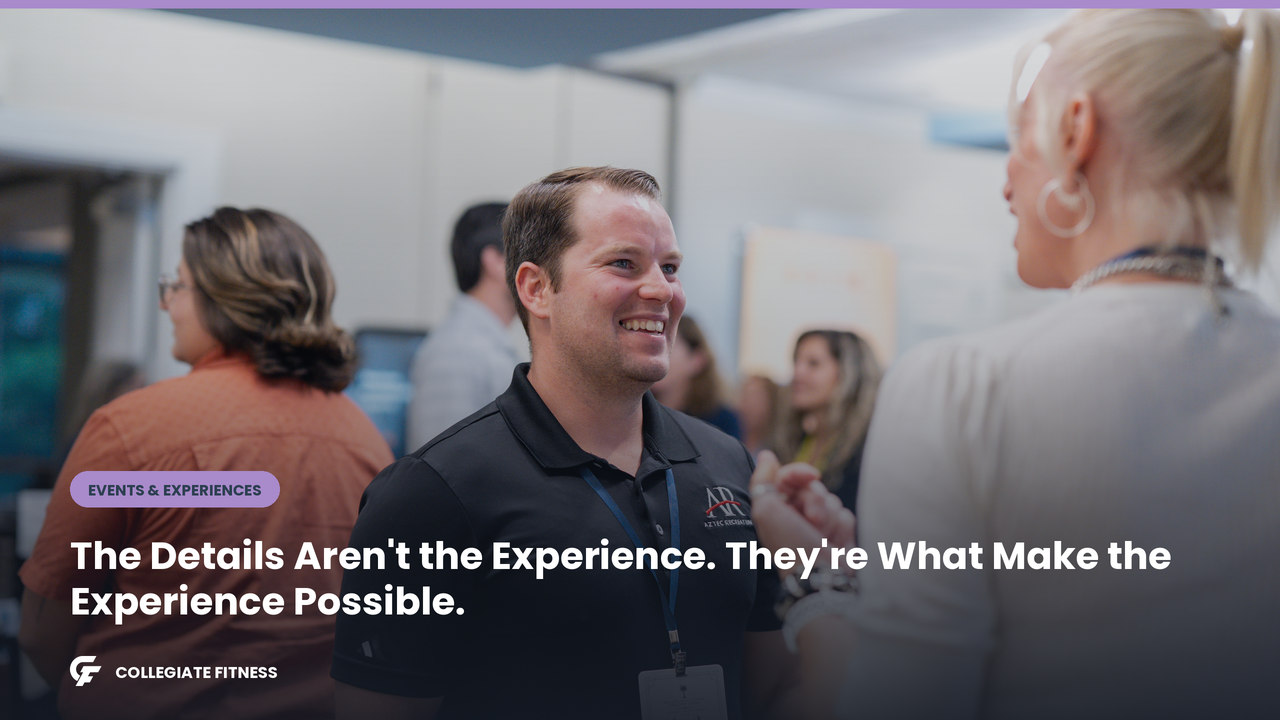
Somewhere in the middle of this year's Summit, walking to lunch with a small group of fitness directors I'd only just met that morning, I realized none of us were talking about anything on the agenda. We were talking about a staffing situation one of them was navigating back home, and someone else was nodding along because she'd lived through something almost identical the year before, and by the time we sat down to eat, the four of us had spent twenty minutes doing something no keynote, however good, could have engineered on its own. We'd found each other. That walk to lunch wasn't a break between the real programming. It was the programming, quietly disguised as something that looked like nothing at all.
I've spent a long time thinking about why that keeps happening at our events, specifically, in a way I don't always see replicated elsewhere, and I've landed on something that shapes almost every decision we make now when we're planning a Summit or a Fit Series stop or anything else we build: the details were never the experience. They're what make the experience possible. Get that backwards, and you can spend an enormous budget on a beautifully produced conference that still leaves people feeling like they came, sat, learned something, and left exactly as alone as they arrived.
What We're Actually Building When We Plan an Event
If you looked only at a typical agenda from one of our Summits, you'd see sessions, speakers, timeslots, the same basic architecture that any professional conference uses to organize itself. What that agenda doesn't show you is the actual thinking behind it, which has almost nothing to do with content sequencing and almost everything to do with a much simpler question: where, in this schedule, are people going to have the chance to actually talk to each other, without an agenda, without a name tag doing the introducing for them, without the pressure of a formal networking session that everyone in the room can feel is a networking session and adjusts their behavior accordingly.
That's why we keep our groups small, deliberately, even when a larger headcount would be the easier business decision. Intimacy isn't a nice byproduct of a smaller event. It's the entire design principle. A room of forty people walking to lunch together in small, shifting clusters produces real conversation. A room of four hundred produces logistics. We've chosen, consistently, to stay closer to the first number than the second, because the thing we're actually selling was never information delivery. Information can be delivered a hundred different ways now, through a webinar, a podcast, an article, none of which require anyone to fly anywhere or take three days away from their program. What can't be delivered that way is the specific, unplanned, slightly vulnerable conversation that happens between two fitness directors who just discovered they're wrestling with the exact same problem, at the exact same time, on opposite sides of the country, and had no idea the other person existed until a shared meal put them at the same table.
Shared Meals Aren't Catering. They're Infrastructure.
I used to think about meals at our events the way most conference organizers probably think about them: a logistical necessity, something to budget for and coordinate, secondary to the actual content of the day. I don't think that anymore, and the shift happened gradually, watching what actually occurred around those tables year after year. A shared meal, done right, without assigned seating pushing people into predetermined groups, does something a formal networking session structurally cannot: it removes the performance of networking entirely, and replaces it with something closer to just eating dinner with people who happen to understand your job better than almost anyone else in your life.
This extends to everything we build around the edges of our formal programming: an afternoon set aside to explore whatever city we're in together, a group Pilates class that has nothing directly to do with collegiate fitness leadership and everything to do with putting people in a room, moving their bodies together, laughing at the same unfamiliar movements, building the kind of low-stakes shared experience that formal sessions rarely allow room for. None of this shows up as a specific line item that anyone would point to and say, "that's where the real value happened." And yet, almost without exception, when I ask people months later what they actually remember from a Summit, it's rarely the keynote content itself, however good that content was. It's the walk. The meal. The class. The moment someone said the thing they'd been carrying alone for a year, out loud, to someone who finally understood exactly what they meant.
Professional Development Requires Leaving the Noise Behind
There's something I've noticed about the people who show up to our events that I think says something important about this entire field, and about why the intentional design matters as much as it does. Everyone who walks through the door still has programs running back home. Still has emails piling up. Still has staff who need them, students who need them, a job that doesn't pause simply because its leader stepped away for three days. And they came anyway, choosing to invest genuine, uninterrupted time in themselves, in a field that spends most of its energy asking its professionals to invest in everyone else.
That choice deserves to be honored by what we actually build for them once they arrive. If someone has taken the real risk of stepping away from their responsibilities to invest in their own growth and community, the last thing we should do is fill every hour with content dense enough that they never actually get the chance to breathe, connect, and remember why this work mattered to them in the first place. The people who develop others, day after day, at their own institutions, need spaces where someone is thinking just as intentionally about developing them. That's not a nice extra layered on top of good programming. It's the whole reason the programming exists.
Why This Philosophy Travels With Us to Savannah
As we look ahead to what comes next, I keep coming back to this same idea, because I think it's the actual thread connecting everything we've built, the Summit, the Fit Series, FitExpo, the Academy. Different formats, different audiences, different stages of a career, but the same underlying belief running through all of it: the content matters, genuinely, and it was never supposed to be the whole story. What actually changes people, what they carry home and remember a year later, happens in the spaces we've been deliberate enough to leave open around it.
We'll keep building those spaces carefully, wherever we go next, because I've watched, over and over, what happens when we get the design right. Someone arrives feeling like the only person in the world dealing with a specific, exhausting problem. Three days later, they leave having found three other people wrestling with the exact same thing, and a plan for how to face it that didn't exist before they walked into a room we built specifically to make that walk to lunch possible. That's the actual product. The sessions were just the reason everyone agreed to show up.
This is exactly the philosophy behind the 2027 Collegiate Fitness Directors Summit, three days in Savannah, June 22-24, at the Andaz Savannah. Early Bird rates run through January 15. If you want to see what we're building and find your people in Savannah, learn more and register here.
Want to Be Part of These Conversations?
If you’re a collegiate fitness or campus recreation professional looking to stay ahead of trends, connect with peers, and bring new ideas back to your program, this is exactly what the Collegiate Fitness Community is built for.
Join a growing network of fitness directors and leaders sharing real strategies, insights, and what’s working right now.
Stay Ahead in Collegiate Fitness
Get insights, trends, and real-world strategies from collegiate fitness leaders. Stay connected to what’s working across campus recreation.
We hate SPAM. Unsubscribe at any time.