
A Community Built for the People Changing Collegiate Fitness: Inside the 2026 Collegiate Fitness Directors Summit
Jul 14, 2026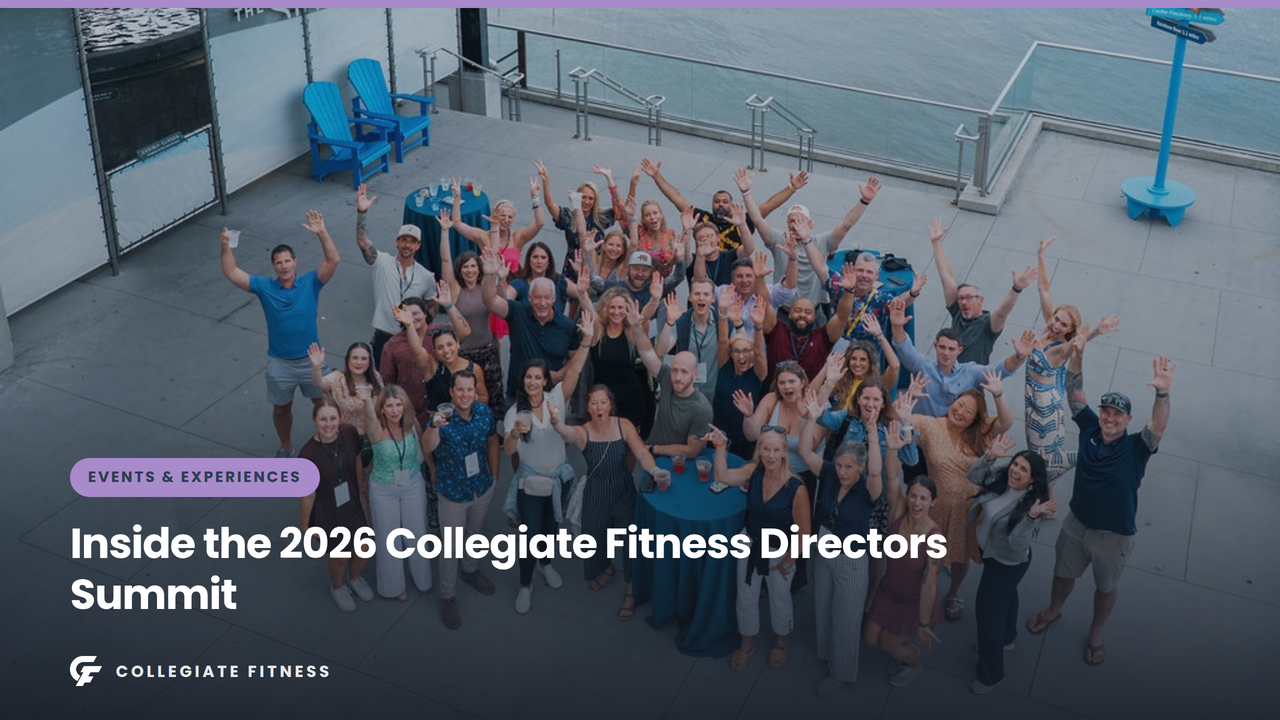
Three days. One city. A community of leaders who spend their careers building belonging for everyone else, finally given a few days to build some of it for themselves.
That's the simplest way to describe what happened in Charleston this year. However, it undersells almost everything that actually made the 2026 Collegiate Fitness Directors Summit presented by IFTA feel different from the usual conference rhythm of sessions, badges, and polite hallway small talk. What actually happened unfolded in two layers at once: a genuinely substantive education program covering some of the most consequential shifts happening in collegiate recreation right now, and underneath that, quieter but no less real, the specific kind of connection that only seems to form when a group of people who rarely get the chance to talk to true peers finally find themselves in a room, then a lunch line, then a walk along the waterfront, with people who understand exactly what their job actually feels like.
Rethinking What Programming Owes This Generation of Students
The Summit opened with a wide-angle look at where collegiate fitness programming is actually headed, and the throughline was harder to miss with each subsequent conversation: the field is moving, deliberately and for good reason, away from an intensity-first model of fitness and toward something built around sustainability, recovery, and genuine belonging. The language of JOMO, the joy of missing out, came up again and again, not as a punchline about a less driven generation, but as a serious reframe of what discipline and consistency actually look like for students who watched burnout consume the adults around them and decided, early and deliberately, not to repeat the experiment.
Recovery emerged as one of the session's most energizing threads, not as a trend to chase but as a genuine philosophy departments are being asked to build into their entire operation, from staff training to facility design to how a schedule gets built around students who can only make it to the gym once a day. Collegiate Fitness Directors traded real stories about converting underused racquetball courts into mobility studios, about the gap between buying recovery equipment and actually teaching students how to use it, and about the surprisingly durable idea that a phrase as small as "find your movement" instead of "find your exercise" might be doing more inclusive work than an entire rebrand ever could. Gamification rounded out the block, with a genuine appetite in the room for quests over challenges, personal progress over public leaderboards, and community events built around fun rather than pure competition, the kind of programming this video-game generation actually responds to.
The Staffing Conversation Nobody Wants to Have Out Loud, Finally Had Out Loud
If one thread ran through every roundtable discussion at Sullivan's Island, Folly Beach, Waterfront Park, and every other table scattered through the staffing and development block, it was this: technical skill was never the reason a great instructor keeps students coming back. Relationships were. Fitness directors traded stories about remembering a staff member's dog's name, about a ten-second check-in before a shift that mattered more than any certification, about the slow, deliberate reframe from "soft skills" to "power skills," a small linguistic shift with real consequences for how departments hire, train, and retain their people.
The idea that kept resurfacing, in one form or another, at nearly every table: people don't leave jobs; they leave situations. That single sentence anchored conversations about onboarding, about mentorship models that rotate new hires through multiple roles before locking them into one, about the deceptively simple discipline of taking work off the table during a check-in and just asking someone how they're actually doing. Nobody in the room needed convincing that belonging drives retention. What the room actually needed, and largely found, was permission to admit how much of that belonging work happens in unglamorous, unbudgeted, entirely human moments that never show up on an org chart.
Marketing That Doesn't Sound Like Marketing
The storytelling and marketing block brought a genuinely useful reframe to a tension nearly every department in the room recognized immediately: the difference between marketing and sales, and the very real cost of expecting one function to do the other's job. A detailed look at how one department built its entire content strategy around real stories rather than promotional campaigns, cycling classes turned into karaoke nights, grip strength challenges that went unexpectedly viral, freshman dorm drops of the group fitness schedule through a residence life partnership, gave the room a concrete, practical model for turning genuinely good programming into content that never feels like an advertisement because it isn't one.
The room's energy shifted noticeably during the discussion of working with, rather than around, centralized university marketing departments. Frustration was real and openly acknowledged. But so was the reframe: coming prepared with a story and real assets, understanding a marketing team's actual timeline instead of assuming urgency will be reciprocated, and staying appreciative even through legitimate frustration, all surfaced as concrete, learnable practices rather than abstract advice. Humans trust humans came up as a genuine rallying phrase by the block's end, a reminder that a student's testimonial will always outperform a polished institutional post, and that the departments getting the most out of their marketing have generally stopped trying to compete with word-of-mouth and started building the conditions for more of it.
Leadership That Starts With the Leader
The Summit's leadership and professional sustainability sessions turned the lens inward, and the room's response made clear how overdue that inward turn was. Burnout came up constantly, but rarely in the generic sense of simply working too much. What surfaced instead, session after session, was a more precise diagnosis: a misalignment between the work professionals were actually doing and the reasons they entered this field in the first place, a slow erosion of growth, autonomy, connection, or enjoyment that no amount of reduced hours alone could fix.
Threaded through nearly every conversation in this block was a framework introduced by Dr. Jessica Matthews, built around four interlocking needs- competence, autonomy, relatedness, and enjoyment- that gave summit attendees a genuinely new vocabulary for naming exactly where their own careers had quietly drifted out of alignment. Conversations about boundaries, about designing a career rather than waiting for one, about the surprising value of nonlinear career paths that don't look like straightforward advancement on paper, all built toward the same underlying message: the people who spend their careers developing others need real, sustained investment in developing themselves, and that investment can't simply be assumed to happen on its own.
The Moments Between the Sessions
Ask anyone who attended what they'll actually remember from this year's Summit, and the honest answer, more often than not, won't be a specific session at all. It will be the walk to lunch when two people realize they are navigating the exact same staffing crisis a thousand miles apart. It will be the group Pilates class that had nothing to do with the agenda and everything to do with people laughing together at their own unfamiliar movements. It will be Dr. Jessica Matthews' closing keynote, weaving together behavioral science, narrative identity, and her own experience of standing at a professional crossroads, landing on a message that seemed to settle over the entire room at once: fear is not a sustainable engine for change, and every person in that room remains, fully, the author of their own next chapter.
Because that's the actual story underneath everything the Summit covered this year. The education mattered, genuinely. But the relationships are what drive the transformation, and for three days, Charleston became a place where collegiate recreation professionals who spend their entire careers building that exact kind of belonging for everyone else finally got to experience it for themselves.
See you in Savannah.
Save the Date
2027 Collegiate Fitness Directors Summit presented by IFTA
June 22-24, 2027 | Savannah, GA
Want to Be Part of These Conversations?
If you’re a collegiate fitness or campus recreation professional looking to stay ahead of trends, connect with peers, and bring new ideas back to your program, this is exactly what the Collegiate Fitness Community is built for.
Join a growing network of fitness directors and leaders sharing real strategies, insights, and what’s working right now.
Stay Ahead in Collegiate Fitness
Get insights, trends, and real-world strategies from collegiate fitness leaders. Stay connected to what’s working across campus recreation.
We hate SPAM. Unsubscribe at any time.